


While some products saw dramatic shifts in their country of origin, America’s overall reliance on Chinese goods and materials has proven hard to dislodge
What you’ll learn in this article:
- Which industries have successfully pivoted away from China.
- Which products America still needs China to produce.
- Which import markets have imploded, and which have stayed robust.
🎯 Best for: Business planners and strategists, supply chain managers, VPs of Procurement.
Data from the U.S. Census shows that tariffs had a significant but modest impact on America’s dependency on Chinese goods, according to an analysis conducted by ImportGenius. The numbers show that, while some Chinese imports plummeted as U.S. purchasers sourced from elsewhere, China remained America’s primary supplier of a broad variety of raw materials and consumer goods.
In a year when the United States imposed seesawing tariff rates on countries around the world, no country was in the crosshairs more than China. U.S. businesses spent much of January and February pre-importing and stockpiling Chinese goods in anticipation of tariffs, which began at 20% in March, then rose as high as 145% in April before settling 30% for most of 2025.
“What we’re seeing in the data is that China has lost its grip on the smartphone and laptop markets in particular, and on some other products as well,” says ImportGenius CEO Michael Kanko. “But for a broad range of both raw materials and consumer goods, those alternative sources have proven hard to find — if they exist at all.”
The data makes one thing clear: tariffs accelerated change where alternatives were available, but dependency persists where China remains essential.
What’s changed: Electronics, footwear, golf carts
For this analysis, ImportGenius reviewed import data for the six-month period from March through August to get a snapshot of how tariffs were impacting trade with China. The most notable change has come in home electronics, whose manufacturers had been reorganizing their supply chains well ahead of the tariffs. The shift away from China has impacted everything from smartphones, laptops and video game consoles to headphones and land-line telephones.
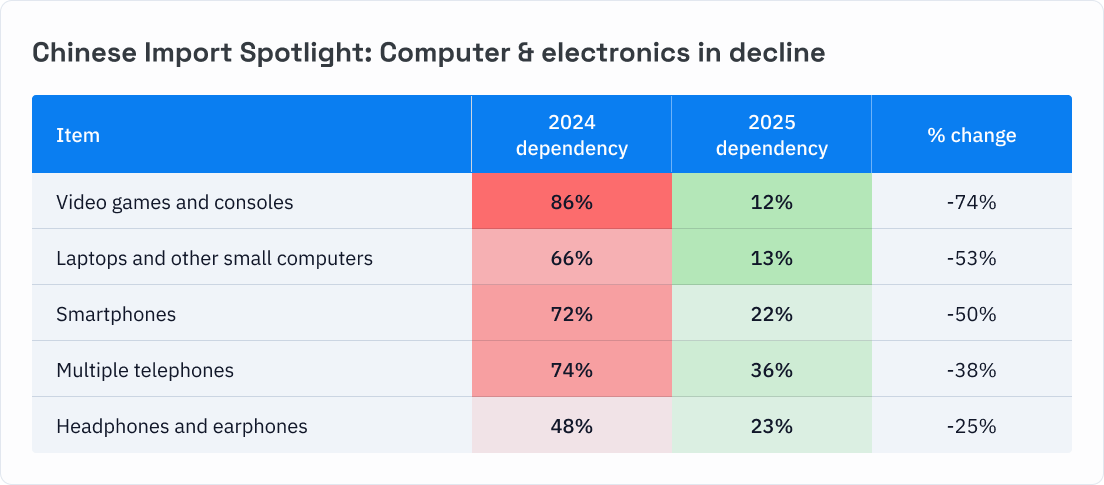
Where China once dominated the manufacture of these items, some now have multiple sources around the world. Video games and consoles, for instance, are now imported in significant volumes from South Korea, Portugal, Japan, Spain and others.
The six-month post-tariff period also saw a significant decline in Chinese imports a selection of other product categories, from golf carts to sports-related footwear to medical gloves.
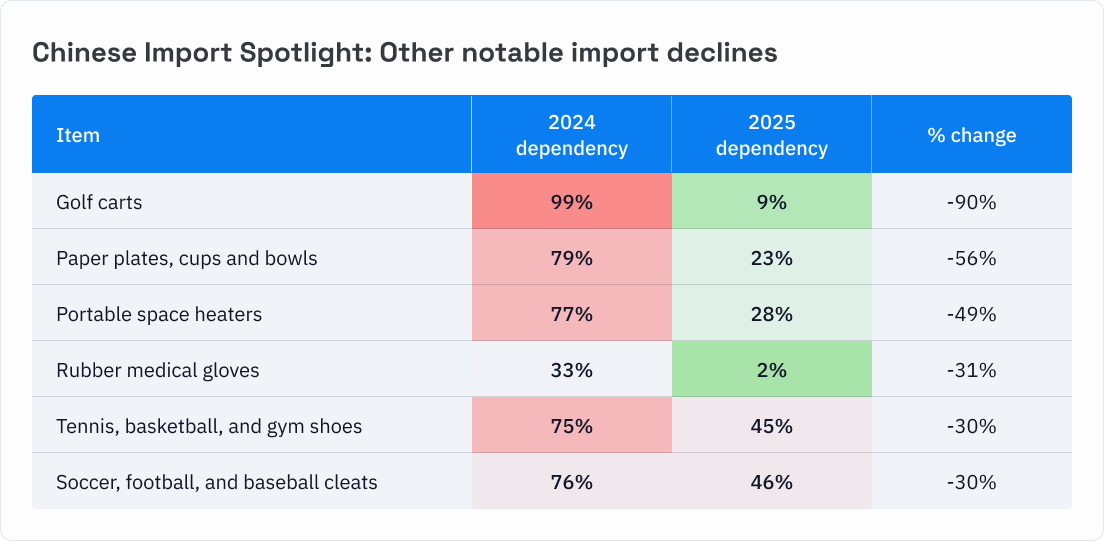
What’s most notable among these products is how the availability of alternative sources impacted imports. For merchandise that was already being manufactured in other countries, such as medical gloves, orders shifted quickly away from China to other locations.
Golf carts, however, are a different story: the market for golf cart imports has essentially collapsed. Across all 12 months of 2024 the U.S. imported $709 million worth of golf carts, $703 million of which came from China. For the six months ranging from March to August of 2025, global golf cart imports totaled a mere $25 million, with only $2 million coming from China.
What’s stayed the same: Kids’ stuff, manufacturing inputs
When The Manifest first reported on Chinese imports last May, we pointed out America’s heavy dependency on China with respect to children’s goods and manufacturing inputs. By and large, those dependencies have not changed, even with heavy tariffs encouraging U.S. businesses to seek out other suppliers.

Unlike the situation with golf carts, where U.S. importers simply stopped purchasing the product, the market for these children’s products has remained robust throughout the imposition of tariffs. “American families simply need these types of products,” says Kanko. “For the time being, it remains hard to raise kids without Chinese goods — and tariffs are making those goods more expensive.”
Meanwhile, America’s advanced manufacturing sector, including defense industries, continue to rely upon China for key materials. ImportGenius’ analysis once again considered three key inputs:
- Manganese is a chemical element essential for the production of glass and high-strength steel, from railways to heavy-duty machinery to gun barrels.
- Artificial corundum, also known as synthetic sapphire, is known for its hardness and is a key ingredient in the production of ceramic armor, used in both personal and vehicle armoring.
- Tungsten is a chemical element highly valued in multiple military applications, including armor-piercing rounds, grenades, artillery parts, aircraft and missiles.
In all three cases, China remains by far the most important supplier of the materials. In fact the dependency has only deepened for tungsten.
What shifting Chinese imports mean for your business
For any business with a presence in global markets, this data shows that trading relationships are in flux. “China remains America’s pre-eminent trading partner,” says Kanko, “but other countries are gaining a share of the U.S. market in every category in which they can compete.”
Rather than signaling a wholesale shift away from China, the data points to a more uneven rebalancing of U.S. supply chains. Some categories have adapted quickly, while others remain highly concentrated, leaving businesses exposed in ways that aren’t always obvious from top-line trade figures alone.
For business leaders planning for 2026, the key takeaway isn’t that dependency has been solved, but that risk now varies sharply by product, supplier, and competitor. Understanding where concentration remains, and how sourcing patterns are evolving in real time — requires visibility at the shipment level.
“This is essential information for any business that’s planning for the years ahead,” says Kanko. “There are lots of competing perspectives and opinions about what businesses should do next, but the containers don’t lie. The trade data can tell you exactly what’s happening now and where things are headed next.”
[CTA]

Make better decisions with trade data

Make better decisions with trade data


More blogs & reports
.png)

